Sunday, March 27, 2011

Chest lid continued

I was able to make the central panel work by instead slightly reducing the two short end pieces of the frame, by about 1/4".  This entailed a good bit of work on the ends, which recieve the male aspects of the tongue and groove frame joinery, but less work than cutting out and planing and grooving a whole new central panel.  The lid still fits the chest just fine.


I pegged the joints but left everything un-glued for maximum mobility with humidity changes.  That is, after all, the whole purpose of going to the trouble of making this top anyway.


Planed smooth the oak pegs are nearly invisible - good looking joint.  I'm really pleased with the lid - and it's heavy.  Drop this on your hand and you're going to feel it.


I like the rough planed texture and much prefer it to a furniture quality planing job.  The 1/16" crack at the joint bugs me, but not enough to spend any more time tightening it up.  There are a lot of moving pieces at work there, and ground you gain on one end, it seems you lose on the other.


Tuesday, March 15, 2011

Underhil Tool Chest

Roy Underhill is the father of so much that is good in our hobby/lifestyle, but one of the nicest things he's cranked out recently is a design for a really fine, traditional "joiner's tool chest" designed to be built with commercially available stock.  Popular Woodworking published an article on it.  He built it on his show and those videos are available free online.  In addition, if you're a user of Google Sketchup (and if you aren't, you're really missing out on this amazing free program), then detailed plans for it are available online.  It is also illustrated and described in one of his books, I believe the most recent one, but I haven't bought it yet so can't say for sure.

Had I thought about it, I would have liked to resize it slightly longer so that it'll hold my 30" long jointer plane, but this gives me an excuse to look for another slightly shorter jointer, something I think it's obvious I badly need...  (rolls eyes) but I like the sobriety imposed on you by a not-limitless capacity.  Do you really need all those planes?  How many saws do you really need?  It goes along with my self imposed ban on tool collecting - I buy what I need, and I use what I buy.  People that have 6 different awls and a dozen back saws, or a thick roll of bench chisels graduated in 1/8" widths make me...well jealous, of course, but also slightly nervous.


The lid is a true floating panel lid which means a long groove must be cut in the end grain of the panel to ride in the grooves on the sides.  This is my tired, wonky old plough plane, but it gets the job done, mostly.  This dry oak was not easy to plough.  The end grain groove I actually rip cut - the plane just couldn't cut end grain oak. 


I started making mine out of some of the large stockpile of oak lumber I had sawn up.  I had several 12" wide boards and picked out a good one that would make all four sides, but remember this chest is designed to use commercially available lumber.  You can go to Home Depot and get oak or poplar 11 1/4" boards that are 3/4" thick, and that's what this chest is designed to be made from.  The bottom of the chest involves a really ingenious skirt board arrangement that adds functional height to the chest, making it more than 11 1/2" deep, adds significant strength, and looks uber traditional and beautiful.  It' a great design.


This is a hard project, don't let Roy's cheerful manner fool you.  The lid is a real challenge, requiring a lot of care with ripping and mortising the corners.  The dovetaling around that skirt is a real logic puzzle.  Hint: plough out the grooves first, then dovetail it together.  And do this after the sides are completely finished.  Measure from your chest, not from drawings or plans, for a proper fit.


Another hint: when making the lid, make the frame first, and assemble (temporarily) and square it up, then measure for the internal floating panel.  I did it the other way around, and now my panel is a little too small to use, even though I tried very hard to cut things precisely.  Things happen - cut yourself some slack, literally.


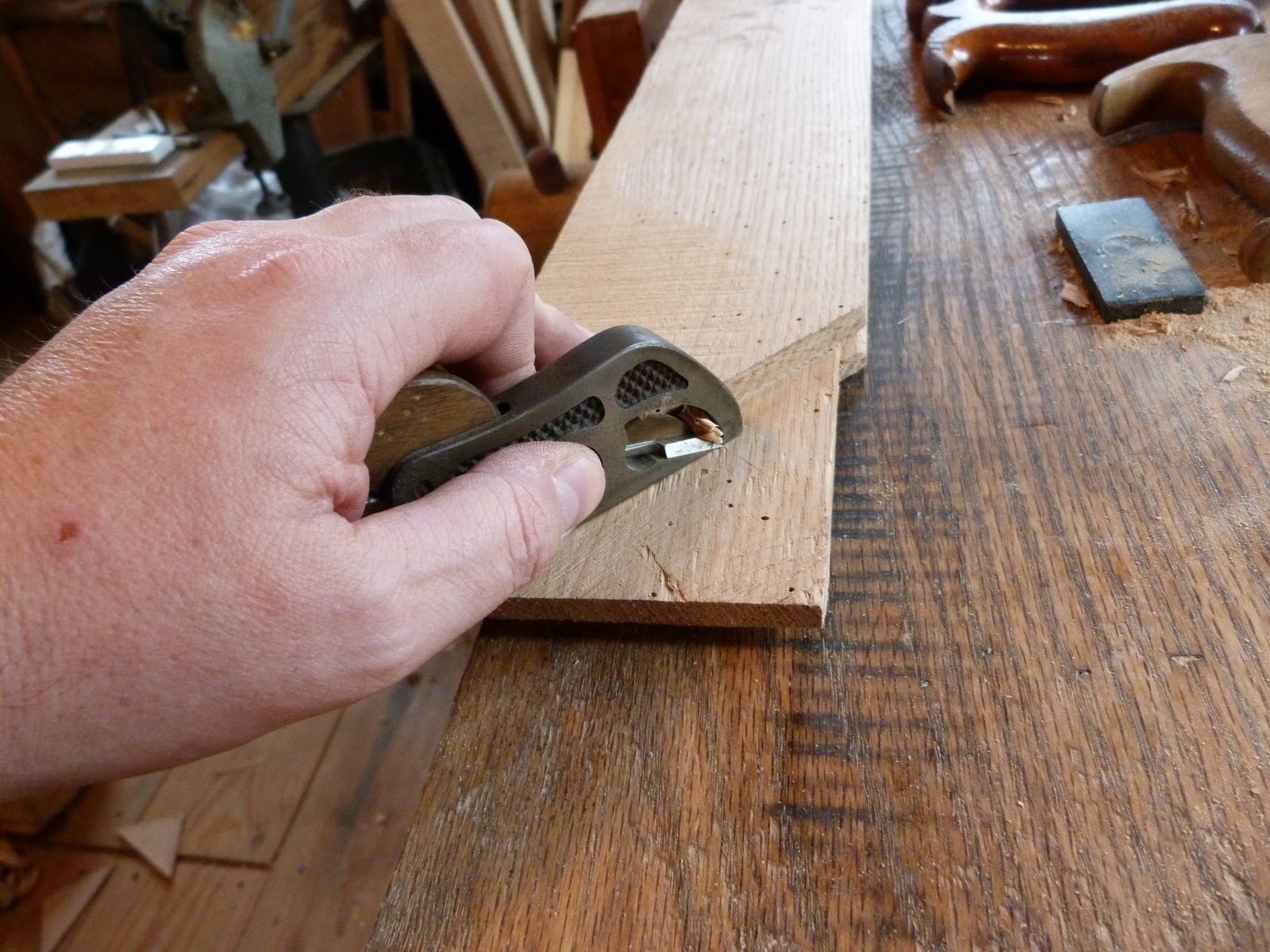
The small Clifton iron plane is really handy for dressing up these thin tenons.


Other than cutting out all the pieces and routing all the grooves on the skirt, this is as far as I've gotten now.  I need to recut the top panel and square up and finish assemble the top.  Next I'll dovetail the sides and skirt and will post photos of that process as I get into it.

I encourage you to try this project.  Unlike some of Roy's wonderful projects, this one has been exhaustively documented and published.  (Try finding good building plans for his treadle lathe...)  You can get good clear poplar from HD or Lowe's and you'll be rewarded with a super tool chest in a good useable size.

Peter Ross will make hinges for you.

Saw Benches

Nothing fancy, but I needed to get around to doing this.  I wanted a pair of rough, stable saw benches, but not benches so nice that I couldn't use them as a base for occasional hewing and axe shaping, which I do a bit of.  A good broad hatchet or shaping axe is a very handy tool for some of the stock shaping I do in gun work, and it's hard to find a place to do it.


I started with two large pieces off of our firewood pile.  The spring rains and winds have blown down several large oaks, and we have an embarrassment of riches in the wood pile.


I simply drilled the billets and cut legs from some 2" oak plank that warped and couldn't be used in making the bench top. 

Sawed, wedged and glued.  Good solid knee-high benches for crosscutting and ripping boards, as well as broad hatchet hewing.


I really love my Swedish hewing hatchett - toughest edge I've ever worked with.


Simple stuff, but it has to be done.  Put it off for too long.  

Wednesday, March 2, 2011

Back after a hiatus...

I apologize to the two or three people who read this blog for my absence during the winter.  I'm back at it, and will be putting up new posts this week.  Lots going on, new camera (I told you so) for Christmas, and the winter blues are behind us.  It's time to sweat and make shavings!

Oh, and I fixed the wax-in-the-dog-hole problem: rosin.  I had a big tub of finely ground rosin I was using to try to mix up a batch of varnish.  The rosin and varnish were failures, but it makes the best holdfast griptionizer you ever saw. 

Thanks for reading.  Drop me a comment.

Saturday, November 6, 2010

New Peter Ross Hold Fasts

Great day in the morning but these are nice.


Brand new hand forged hold fasts (and is that one word or two?) from master blacksmith Peter Ross, late of Colonial Williamsburg and acknowledged as one of America's great artisans.  If you want to see iron work that will make your jaw drop, drop by his website:

There are several more or less successful attempts at a factory made holdfast on the market.  There is even a typically over-engineered one that uses a threaded screw to provide downward pressure, so it's really more of a benchtop downward acting vise than anything.  Some of the true friction-action holdfasts have a bad reputation for fracturing under repeated use - that will never happen with these beauties.  You hold them in your hand and you just know that 150 years from now they'll be on somebody's bench - maybe a great great grandson or daughter if you're lucky and raise 'em right.


Of course you know how they work.  There is a 3/4" hole drilled in the bench top, or in the skirt boards, and into it you drop the holdfast.  Whack it down with a couple of mallet blows, and friction works its magic.  To release, just whack the back, behind the bend, and it's free.  Simplicity itself.  Needs no lubrication.  Y2K compliant. 


In the skirt board, they provide amazing holding power.  One end of the board in the vise or under the planing hook and the other under a holdfast and you're good for all the planing you'd ever need to do.  When finished, whack it and you're outa there.

They cost a good bit more than the rinky dink factory jobs, but there comes a time in a person's life when they've had enough of rinky dink and want to have something solid and beautiful and basically perfect in their kit, something that will last 200 years of daily use, for the price of a couple of dinners out.

Peter's standard model is made for a 7/8" hole - I got the 3/4" by request because I already had the holes drilled for the small Jorgensen bench stops discussed earlier.  Even scaled down slightly, they are massive and I can't imagine any need for a larger model unless you're holding down really massive work pieces.  

To my chagrin, I waxed some of the holes to make the bench stops easier to turn and to insert and remove, and now they are completely useless for holdfast use and will not grip, no matter what.  So let that be a lesson to you - don't wax your bench holes if you want to use these puppies or you'll be sad.  

And to all those of you facing an onslaught of post modernist, over engineered frippery in the workshop, I have two words of advice for you, courtesy of Patrick O'Brian:


Tuesday, October 19, 2010

The Greatest Album in the World

High Atmosphere: Ballads and Banjo Tunes from Virginia and North Carolina Collected by John Cohen in


Not words to bandy about lightly, I know.  But if I could only grab one album of music to take on the last spaceship leaving Earth, I think I would get this one.  Plenty of other people will bring "Hotel California" and I'm sure there will be plenty of Beethoven and Grateful Dead to keep us satisfied on our multi-year trip to Alpha Centauri.  But there might not be anything like this, or certainly anything as good as this, and that would be, as the saying goes, a crying shame.

I try to keep fluff to a minimum on this blog, but we must digress occasionally.  A little poetry and music never hurt anyone and you do better work if you have tunes to listen to while you're pushing a file.

"High Atmosphere", a compilation of recordings made in the Appalachian mountains in 1965 by John Cohen, was originally released in 1975.  What's a nice Jewish boy doing in the mountains of Virginia and North Carolina?  Snagging the finest authentic mountain music ever recorded, that's what.  There are lots of other albums of original music out there, some of them splendid, some of them merely amusing, some pretty forgettable.  As with rifles and houses and furniture, just because it's old doesn't mean it's good.  But this music is good.  No, it's great.  And I mean great in the Julius Caesar sense of the word.  Thanks to Cohen, this music will live forever.  It was re-released in 1995, apparently with new material added, although I haven't compared the song list to my original vinyl LP to see what's been added.  (The pre-1995 CD did not have all the songs from the LP - I believe two were missing.  Be sure and get the 1995 re-release.)

If you have no prior experience with original recordings of Appalachian music, you are missing out.  Even if you don't wind up liking it, you should acquaint yourself briefly with it and keep some on hand in case you need a look into the past, (or you have some really cool friends over for moonshine and barefoot wrestling.)  This music is unaffected, raw, honest, unapologetic, spontaneous, joyous, and dreadfully sad.  Some of it is absolutely chilling.  Lloyd Chandler's "Remember and Do Pray For Me" will lift the hair off your head, as does his "A Conversation With Death."  Wade Ward's "Shady Grove" may be the finest version of this classic tune ever recorded.  Dellie Norton's two wonderful (possibly Elizabethan) ballads are sung in a voice that cannot be described easily in words.

There is a lot more of this music out there.  The magnificent "Mountain Music of Kentucky" is almost as good, and is more wide reaching in styles represented.  Bascom Lamar Lunsford's  "Ballads, Banjo Tunes and Sacred Songs of North Carolina" is exceptional and shows one man's ability to both fully appreciate this music as well as authentically create it himself.  Tommy Jarrell's albums are seminal fiddle recordings.  Roscoe Holcombe is the Bob Dylan and Robert Johnson of this music rolled into one.  But there is no collection of Appalachian music that will wither you where you stand quite as effectively as "High Atmosphere."

Available on Rounder Records as well as Amazon.com and Emusic.com.  Incidentally, if you're into this stuff, a subscription to Emusic.com will give you access to vast quantities of original recordings of Appalachian, early country, and blues, back before the suits got ahold of our ancestors' music and made it into the flavorless paste that it is now.

Helpful links, no extra charge:


The Legacy Of Tommy Jarrell, Vol. 1: Sail Away Ladies

Monday, October 11, 2010

Rifle carving

A quick photo from last week showing the ground work done on my rifle.  Backgrounds taken down and smoothed.  The next step is modelling the carving, or putting in the three dimensional detail, although this pattern is pretty simple and in keeping with the spirit of the rifles on which it is based.


The rifle now, at present, is carved and has it's asphaltum stain on, and the first coat of oil.  Will add photos soon.  The asphaltum was a success, but very very BROWN.  No reddish cast at all, so I augmented with a little red stained oil.  Very nice so far.